

As the Q2 earnings season comes to a close, it’s time to take stock of this quarter’s best and worst performers in the processors and graphics chips industry, including Allegro MicroSystems (NASDAQ:ALGM) and its peers.
The biggest demand drivers for processors (CPUs) and graphics chips at the moment are secular trends related to 5G and Internet of Things, autonomous driving, and high performance computing in the data center space, specifically around AI and machine learning. Like all semiconductor companies, digital chip makers exhibit a degree of cyclicality, driven by supply and demand imbalances and exposure to PC and Smartphone product cycles.
The 9 processors and graphics chips stocks we track reported a very strong Q2. As a group, revenues beat analysts’ consensus estimates by 6.3% while next quarter’s revenue guidance was 6.8% above.
While some processors and graphics chips stocks have fared somewhat better than others, they have collectively declined. On average, share prices are down 1.3% since the latest earnings results.
Allegro MicroSystems (NASDAQ:ALGM)
The result of a spinoff from Sanken in Japan, Allegro MicroSystems (NASDAQ:ALGM) is a designer of power management chips and distance sensors used in electric vehicles and data centers.
Allegro MicroSystems reported revenues of $259.2 million, up 27.5% year on year. This print exceeded analysts’ expectations by 3.1%. Overall, it was an exceptional quarter for the company with a beat of analysts’ EPS estimates and a solid beat of analysts’ operating income estimates.
“We began fiscal 2027 with strong momentum, delivering our sixth consecutive quarter of sales growth. Fiscal first quarter sales were $259 million, representing a 27% increase year-over-year. GAAP earnings per share improved to $0.08 in fiscal first quarter 2027 from a $0.07 loss per share in fiscal first quarter 2026. Non-GAAP EPS grew for the fifth consecutive quarter to $0.23, increasing more than 2.5x over the first quarter of fiscal 2026. These results were led by data center, which reached a record 17% of total sales, and by continued strength in xEV and ADAS,” said Mike Doogue, President and CEO of Allegro MicroSystems.
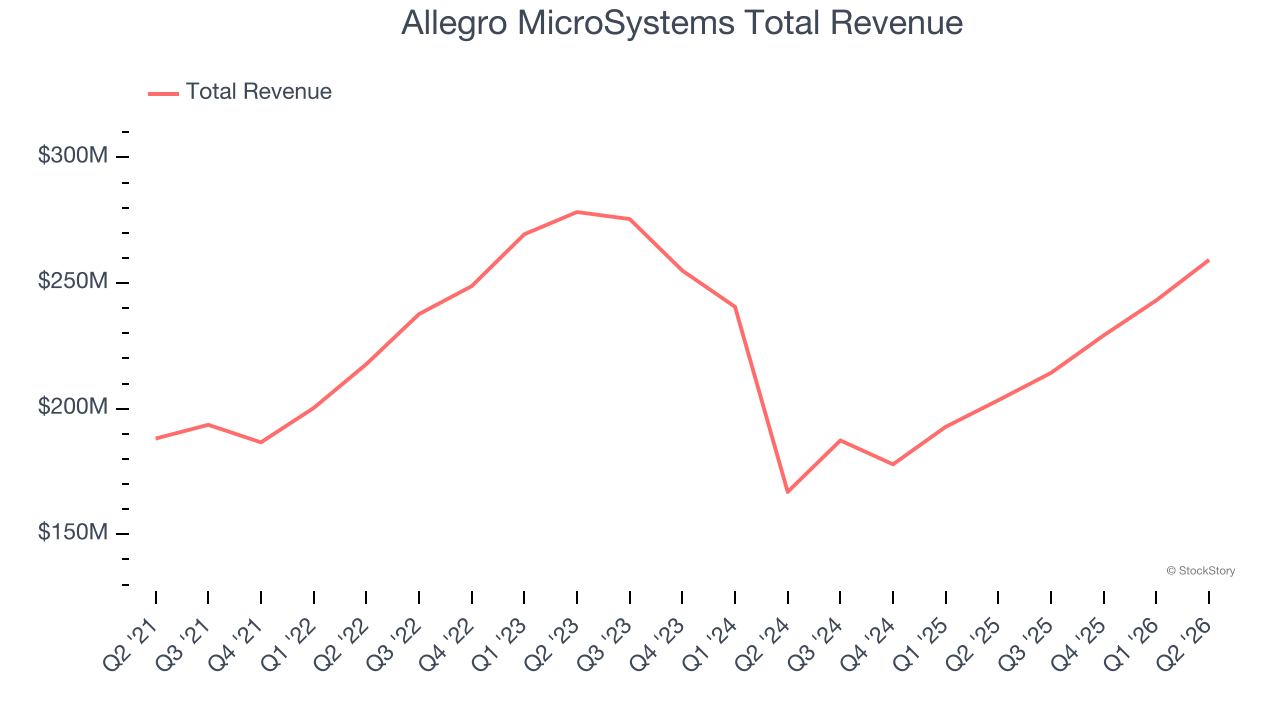
Investor expectations, however, were likely higher than Wall Street’s published projections, leaving some wishing for even better results (analysts’ consensus estimates are those published by big banks and advisory firms, not the investors who make buy and sell decisions). The stock is down 14.7% since reporting and currently trades at $36.00.
Is now the time to buy Allegro MicroSystems? Access our full analysis of the earnings results here, it’s free.
Best Q2: Intel (NASDAQ:INTC)
Inventor of the x86 processor that powered decades of technological innovation in PCs, data centers, and numerous other markets, Intel (NASDAQ:INTC) is a leading manufacturer of computer processors and graphics chips.
Intel reported revenues of $16.13 billion, up 25.4% year on year, outperforming analysts’ expectations by 11.7%. The business had an incredible quarter with a significant improvement in its inventory levels and a beat of analysts’ EPS estimates.
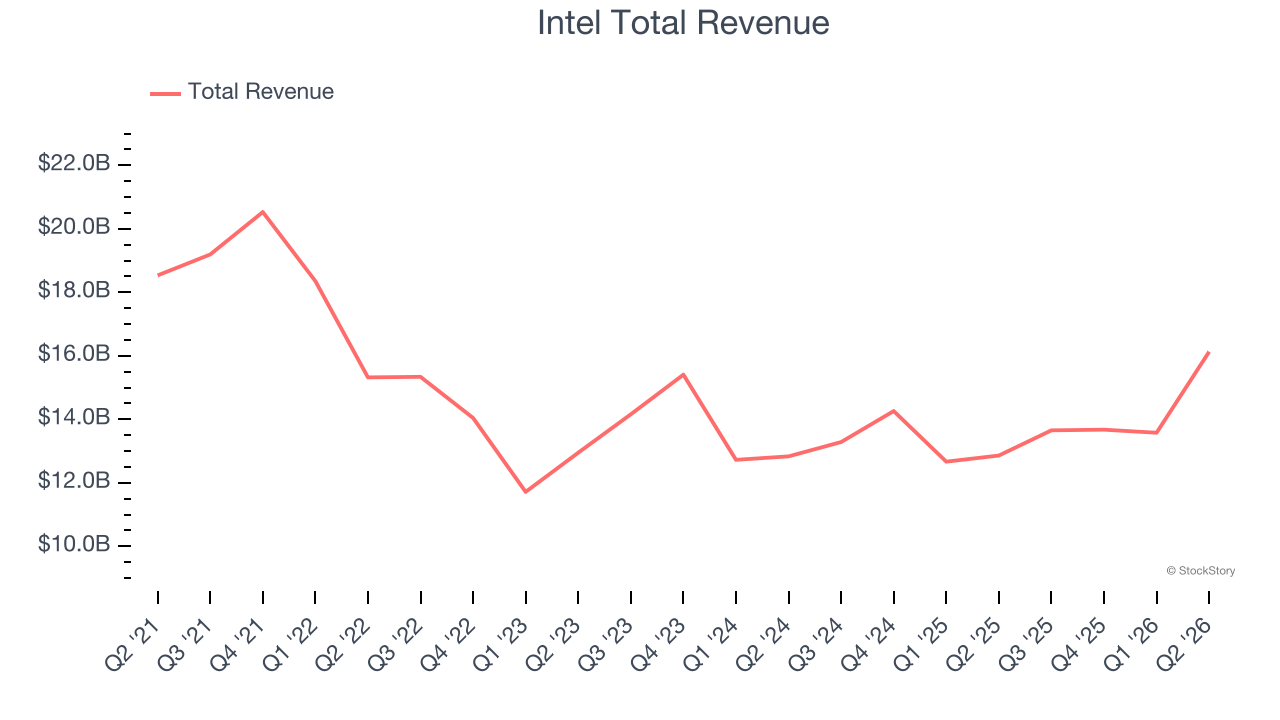
The market seems happy with the results as the stock is up 5.4% since reporting. It currently trades at $105.63.
Is now the time to buy Intel? Access our full analysis of the earnings results here, it’s free.
Weakest Q2: Qualcomm (NASDAQ:QCOM)
Having been at the forefront of developing the standards for cellular connectivity for over four decades, Qualcomm (NASDAQ:QCOM) is a leading innovator and a fabless manufacturer of wireless technology chips used in smartphones, autos and internet of things appliances.
Qualcomm reported revenues of $9.95 billion, down 4% year on year, exceeding analysts’ expectations by 3%. Still, it was a mixed quarter as it posted an increase in its inventory levels.
Interestingly, the stock is up 13.2% since the results and currently trades at $176.23.
Read our full analysis of Qualcomm’s results here.
AMD (NASDAQ:AMD)
Founded in 1969 by a group of former Fairchild semiconductor executives led by Jerry Sanders, Advanced Micro Devices (NASDAQ:AMD) is one of the leading designers of computer processors and graphics chips used in PCs and data centers.
AMD reported revenues of $11.54 billion, up 50.1% year on year. This result surpassed analysts’ expectations by 1.7%. It was a strong quarter as it also put up a meaningful improvement in its inventory levels and revenue guidance for next quarter topping analysts’ expectations.
The stock is flat since reporting and currently trades at $520.47.
Read our full, actionable report on AMD here, it’s free.
Lattice Semiconductor (NASDAQ:LSCC)
A global leader in its category, Lattice Semiconductor (NASDAQ:LSCC) is a semiconductor designer specializing in customer-programmable chips that enhance CPU performance for intensive tasks such as machine learning.
Lattice Semiconductor reported revenues of $201.1 million, up 62.2% year on year. This print beat analysts’ expectations by 8.6%. Overall, it was a stunning quarter as it also logged a beat of analysts’ EPS estimates and a solid beat of analysts’ operating income estimates.
Lattice Semiconductor achieved the highest guidance raise of the whole group. The stock is down 16.3% since reporting and currently trades at $115.50.
Read our full, actionable report on Lattice Semiconductor here, it’s free.
Market Update
Over the past year, investors have been forced to repeatedly answer the same question: what is the market’s biggest risk? The answer has changed several times, and each shift has reshaped market leadership.
Late in 2025 and early 2026, artificial intelligence became the market’s primary uncertainty. Investors questioned whether AI would erode software pricing power and weaken competitive moats as AI made it easier to replicate once-differentiated products.
By the spring, technology took a back seat to geopolitics. The U.S. conflict with Iran briefly became the market’s dominant narrative, raising concerns about oil prices, inflation, and global growth. But as energy markets remained orderly and fears of a prolonged supply disruption faded, investors quickly turned their focus back to fundamentals.
Want to invest in winners with rock-solid fundamentals? Check out our Top 6 Stocks and add them to your watchlist. These companies are poised for growth regardless of the political or macroeconomic climate.