

Quarterly earnings results are a good time to check in on a company’s progress, especially compared to its peers in the same sector. Today we are looking at Himax (NASDAQ:HIMX) and the best and worst performers in the analog semiconductors industry.
Demand for analog chips is generally linked to the overall level of economic growth, as analog chips serve as the building blocks of most electronic goods and equipment. Unlike digital chip designers, analog chip makers tend to produce the majority of their own chips, as analog chip production does not require expensive leading edge nodes. Less dependent on major secular growth drivers, analog product cycles are much longer, often 5-7 years.
The 14 analog semiconductors stocks we track reported a very strong Q2. As a group, revenues beat analysts’ consensus estimates by 1.8% while next quarter’s revenue guidance was 4.9% above.
While some analog semiconductors stocks have fared somewhat better than others, they have collectively declined. On average, share prices are down 4.2% since the latest earnings results.
Himax (NASDAQ:HIMX)
Taiwan-based Himax Technologies (NASDAQ:HIMX) is a leading manufacturer of display driver chips and timing controllers used in TVs, laptops, and mobile phones.
Himax reported revenues of $227.4 million, up 5.9% year on year. This print exceeded analysts’ expectations by 2%. Despite the top-line beat, it was still a slower quarter for the company with EPS in line with analysts’ estimates.
“Notwithstanding industry-wide supply constraints, we remain optimistic about the long-term growth prospects of our automotive display IC business. We continue to view automotive as one of the industry's most attractive secular growth markets, driven by rapid advancements in smart vehicle interiors, characterized by a growing number of displays per vehicle, along with larger, higher-resolution displays and more diverse vehicle cabin configurations. Himax is well positioned to capitalize on these industry trends through our comprehensive automotive display portfolio spanning both LCD and OLED technologies, a broad and diversified global customer base, and a robust design-win pipeline. The industry's ongoing pursuit of richer human-machine interfaces, immersive infotainment, and enhanced in-cabin user experiences is driving the adoption of a broader range of our display technologies. This not only increases Himax's dollar content per vehicle but also creates multiple long-term growth opportunities,” said Mr. Jordan Wu, President and Chief Executive Officer of Himax.
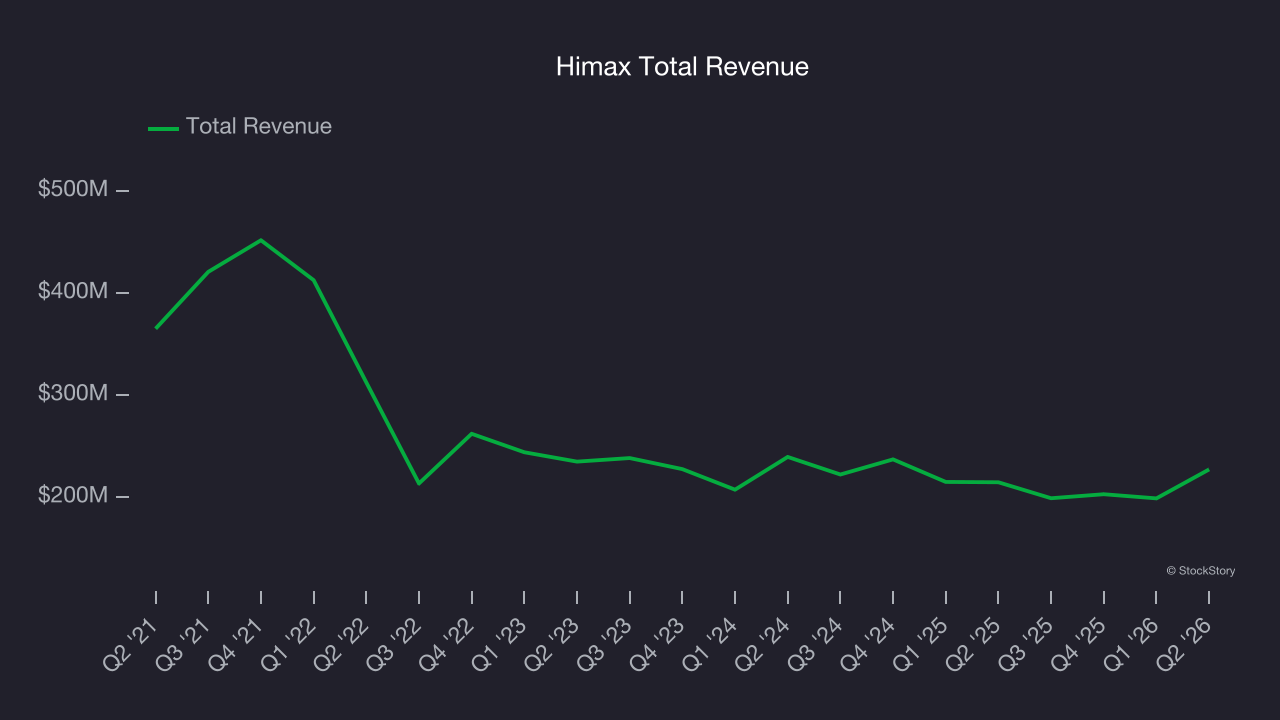
The market seems disappointed with the results as the stock is down 10.3% since reporting and currently trades at $11.97.
Read our full report on Himax here, it’s free.
Best Q2: Monolithic Power Systems (NASDAQ:MPWR)
Founded in 1997 by its longtime CEO Michael Hsing, Monolithic Power Systems (NASDAQ:MPWR) is an analog and mixed signal chipmaker that specializes in power management chips meant to minimize total energy consumption.
Monolithic Power Systems reported revenues of $980.6 million, up 47.6% year on year, outperforming analysts’ expectations by 8.6%. The business had an incredible quarter with a significant improvement in its inventory levels and a beat of analysts’ EPS estimates.
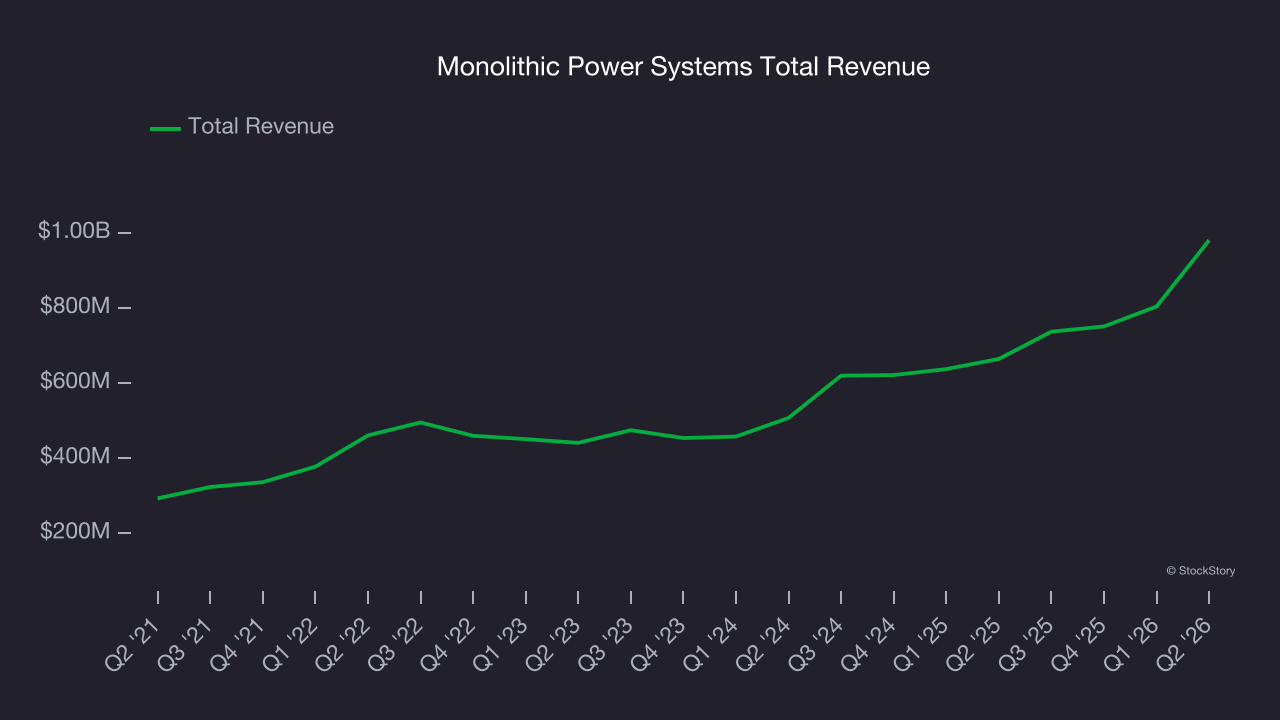
Monolithic Power Systems pulled off the biggest analyst estimate beat, highest guidance raise, and fastest revenue growth among its peers. Although it had a fine quarter compared to its peers, the market seems unhappy with the results as the stock is down 6.7% since reporting. It currently trades at $1,228.
Is now the time to buy Monolithic Power Systems? Access our full analysis of the earnings results here, it’s free.
Universal Display (NASDAQ:OLED)
Serving major consumer electronics manufacturers, Universal Display (NASDAQ:OLED) is a provider of organic light emitting diode (OLED) technologies used in display and lighting applications.
Universal Display reported revenues of $152.2 million, down 11.4% year on year, falling short of analysts’ expectations by 3.6%. It was a mixed quarter as it posted a beat of analysts’ EPS estimates.
Universal Display delivered the weakest performance against analyst estimates and slowest revenue growth of the whole group. As expected, the stock is down 6.7% since the results and currently trades at $74.99.
Read our full analysis of Universal Display’s results here.
Impinj (NASDAQ:PI)
Founded by Caltech professor Carver Mead and one of his students Chris Diorio, Impinj (NASDAQ:PI) is a maker of radio-frequency identification (RFID) hardware and software.
Impinj reported revenues of $108.4 million, up 10.7% year on year. This number topped analysts’ expectations by 3.5%. It was a stunning quarter as it also produced a significant improvement in its inventory levels and a beat of analysts’ EPS estimates.
The stock is up 35.6% since reporting and currently trades at $188.91.
Read our full, actionable report on Impinj here, it’s free.
Texas Instruments (NASDAQ:TXN)
Headquartered in Dallas, Texas since the 1950s, Texas Instruments (NASDAQ:TXN) is the world’s largest producer of analog semiconductors.
Texas Instruments reported revenues of $5.46 billion, up 22.8% year on year. This print surpassed analysts’ expectations by 3.8%. Overall, it was an exceptional quarter as it also logged a beat of analysts’ EPS estimates and an impressive beat of analysts’ operating income estimates.
The stock is down 5.4% since reporting and currently trades at $278.45.
Read our full, actionable report on Texas Instruments here, it’s free.
Market Update
Over the past year, investors have been forced to repeatedly answer the same question: what is the market’s biggest risk? The answer has changed several times, and each shift has reshaped market leadership.
Late in 2025 and early 2026, artificial intelligence became the market’s primary uncertainty. Investors questioned whether AI would erode software pricing power and weaken competitive moats as AI made it easier to replicate once-differentiated products.
By the spring, technology took a back seat to geopolitics. The U.S. conflict with Iran briefly became the market’s dominant narrative, raising concerns about oil prices, inflation, and global growth. But as energy markets remained orderly and fears of a prolonged supply disruption faded, investors quickly turned their focus back to fundamentals.
Want to invest in winners with rock-solid fundamentals? Check out our Hidden Gem Stocks and add them to your watchlist. These companies are poised for growth regardless of the political or macroeconomic climate.