
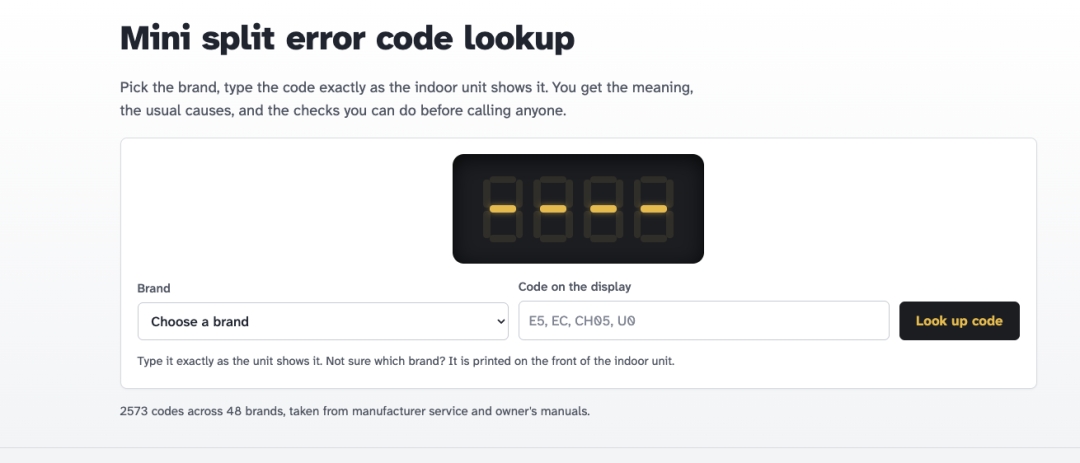
Los Angeles, California - September 8th, 2026 - DIY HVAC Tools today announced the launch of its new Mini Split Error Code Lookup Tool, a free online resource designed to make troubleshooting ductless mini split systems faster and easier. The database currently includes more than 2,500 error codes covering 48 mini split and HVAC brands, giving homeowners, technicians, installers, and DIY users a centralized place to research codes displayed by their systems.
Mini split air conditioners and heat pumps increasingly rely on onboard electronics and diagnostic systems to identify operating problems. When something goes wrong, an indoor unit may display a short code such as E1, E5, EC, CH05, U0, or another combination of letters and numbers.
The problem is that these codes are not standardized across the HVAC industry. The same code can have a completely different meaning depending on the manufacturer and, in some cases, the specific model or product generation.
The new Mini Split Error Code Lookup from DIY HVAC Tools is intended to simplify that process.
Users select the manufacturer of their mini split, enter the code exactly as it appears on the unit, and receive information about what the code generally means, common causes associated with it, and checks that may be performed before contacting a service technician.
The tool is available free through DIY HVAC Tools.
More Than 2,500 Mini Split Error Codes in One Database
At launch, the Mini Split Error Code Lookup contains 2,573 codes covering 48 brands. The database was compiled using information from manufacturer service manuals and owner's manuals.
Brands represented include ACiQ, Ameristar, Arctic King, Blueridge, Bosch, Bryant, Carrier, Cooper & Hunter, Daikin, Friedrich, Fujitsu, GE Appliances, Goodman, Gree, Haier, LG, Lennox, Midea, Mitsubishi Electric, MRCOOL, Panasonic, Pioneer, Rheem, Ruud, Samsung, Senville, TCL, Trane, York, Zone Air and numerous others.
Rather than requiring users to locate the correct manual and search through dozens or hundreds of pages, DIY HVAC Tools organizes the information around the piece of information users already have: the error code appearing on their system.
The database can also be browsed by brand, allowing users to see available codes for a particular manufacturer.
Designed to Make Mini Split Troubleshooting Easier
Modern inverter-driven mini splits can monitor numerous components and operating conditions, including temperature sensors, communication between indoor and outdoor equipment, refrigerant conditions, compressor operation, fan motors, electrical voltage and system protection functions.
As a result, an error code does not always mean that a component has permanently failed.
Some codes indicate faults, while others represent protection functions in which the system intentionally stops or limits operation after detecting an abnormal condition. Examples can include improper voltage, excessive temperatures, coil freeze protection or other operating conditions.
Understanding that distinction can be useful when deciding what to do next.
DIY HVAC Tools also provides guidance for reading seven-segment displays, where certain letters and numbers can look similar. For example, a zero may resemble the letter “O,” while other characters can be difficult to distinguish depending on the display.
The site recommends beginning with the system's brand because error-code definitions can vary significantly between manufacturers.
Helping Homeowners Make More Informed Decisions
The growth of DIY-friendly mini splits has made ductless HVAC equipment accessible to a broader range of homeowners. At the same time, troubleshooting these increasingly sophisticated systems can still be confusing.
The Mini Split Error Code Lookup is intended to bridge part of that information gap.
A homeowner who sees an unfamiliar code can use the tool to determine whether it may be related to communication, a temperature sensor, voltage, refrigerant conditions, a fan motor or another part of the system.
That information can help users better understand the problem before deciding whether a simple inspection is appropriate or professional service is needed.
It can also help users communicate more effectively with an HVAC technician. Instead of reporting only that a mini split “stopped working,” a homeowner can provide the manufacturer, displayed code and the general fault category.
The lookup is intended as a reference rather than a substitute for manufacturer instructions or professional diagnosis. Error codes and their definitions can vary between models and production years, and DIY HVAC Tools recommends confirming information against the manual for the specific equipment before purchasing replacement parts or performing repairs.
Useful for HVAC Technicians and Installers, Too
Although the tool was designed to be approachable for homeowners, it can also serve as a quick reference for HVAC contractors, service technicians and installers who encounter equipment from many manufacturers.
Mini split technicians may work on several brands in a single week, each with its own diagnostic terminology and error-code structure. Having a searchable database can provide a convenient starting point when encountering an unfamiliar code in the field.
The database includes both widely recognized HVAC manufacturers and brands frequently encountered in the growing DIY and value-oriented mini split market.
That broad coverage is particularly important as the U.S. ductless HVAC market becomes more diverse and homeowners purchase equipment through a wider variety of retailers and online channels.
A Free Reference Built Around Manufacturer Documentation
DIY HVAC Tools says its error-code database is based on manufacturer service and owner's manuals rather than treating error codes as universal definitions.
That distinction is important because identical-looking codes can represent very different conditions on different systems.
For example, communication faults, sensor faults, refrigerant-related conditions and electrical protections may use overlapping combinations of letters and numbers depending on the equipment manufacturer.
The Mini Split Error Code Lookup therefore asks users to identify the brand before entering the displayed code.
In addition to individual lookup results, users can browse error codes by manufacturer and review commonly searched mini split codes.
The tool also explains basic troubleshooting concepts, including the difference between a fault and a protection condition and why repeatedly resetting equipment without identifying the underlying problem may not resolve the issue.
Part of a Growing Collection of DIY HVAC Resources
The launch of the Mini Split Error Code Lookup reflects DIY HVAC Tools' broader goal of making technical HVAC information easier for homeowners to find and understand.
As ductless systems become more common, homeowners increasingly encounter technical information that historically appeared primarily in installer and service documentation.
Organizing that information into accessible online tools can make it easier for consumers to understand their equipment while still recognizing when professional diagnosis or repair is necessary.
The Mini Split Error Code Lookup is available now and can be accessed through DIY HVAC Tools' Mini Split Error Code Lookup.
About DIY HVAC Tools
DIY HVAC Tools is an independent online HVAC reference focused on creating practical tools and resources for homeowners, DIY installers, and HVAC professionals. Its resources are designed to simplify technical HVAC information and help users better understand, size, troubleshoot, and maintain heating and cooling equipment.
DIY HVAC Tools is not affiliated with the HVAC manufacturers included in its error-code database. Error-code definitions may vary by model and year, and users should confirm diagnostic information with the documentation supplied by their equipment manufacturer before performing repairs.
More info: diyhvactools.com
Media Contact
Company Name: DIY HVAC Tools
Contact Person: Andrew Leonard
Email: Send Email
Country: United States
Website: https://diyhvactools.com/mini-split-error-code-lookup/