
Financial Professional Economic Outlook Index rose to 57 (from 55 in Q2) as economic concerns eased, while widespread AI adoption reshaped advisor practices and client conversations
Financial professionals had easing concerns around inflation and recession during the third quarter, while artificial intelligence (“AI”) was becoming a significant part of both their practices and client conversations, according to Security Benefit’s Q3 Survey of Financial Professionals. Security Benefit’s Financial Professional Economic Outlook Index rose to 57 from 55 in Q2, reflecting improved expectations around inflation and recession.
This press release features multimedia. View the full release here: https://www.businesswire.com/news/home/20261013758912/en/
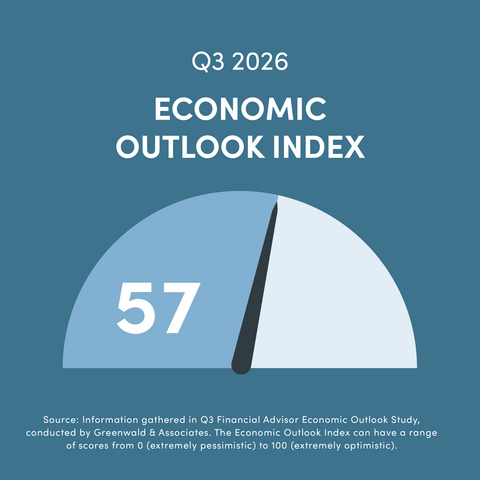
Security Benefit’s Q3 2026 Financial Professional Economic Outlook Index rose to 57 from 55 in Q2, reflecting improved expectations around inflation and recession. The Index measures financial professionals’ economic outlook on a scale of 0 (extremely pessimistic) to 100 (extremely optimistic).
“Market uncertainty remained a challenge to address in the advisor-client relationship,” said Justin Jacquinot, Senior Vice President and Head of IMO and RIA Channels at Security Benefit. “Our survey numbers showed that advisors had become a bit more optimistic on the economy, but the recent rate hike caused volatility to spike for both stocks and bonds. As such, clients continue to need retirement options that provide growth potential and protection from uncertainty.”
Economic Confidence Improved as Inflation and Recession Concerns Eased
Prior to the Fed rate hike in September, financial advisors’ inflation concerns had fallen notably in the third quarter, with just 13% expecting inflation to reach 4% or higher over the next 12 months, down from 24% in Q2. Meanwhile, 60% had expected inflation to fall between 3% and 3.9%, compared with 51% last quarter.
Recession concerns had also eased, with 62% of financial professionals seeing a low or almost no likelihood of a recession over the next 12 months, up from 56% in Q2. Just 6% saw a high or almost certain likelihood of a recession, down from 10% in the last quarter.
Financial professionals remained optimistic about equity markets, with more than half (54%) expecting the S&P 500 to be at least 6% higher in 12 months. At the same time, expectations for increased volatility moderated, falling to 42% from 49% in Q2.
AI Became More Embedded in Advisor Practices and Client Conversations
Conducted in partnership with Greenwald Research, the survey found AI is already widely embedded in financial professionals’ practices and increasingly shaping client conversations.
More than eight in ten financial professionals (85%) currently use AI in their practices. The most common use cases include notetaking or meeting transcription (49%), summarizing market or investment research (47%) and drafting client communications (43%). Interestingly, about 12% of advisors are now using AI to build client investment portfolios, most often for asset allocation ideas or product research.
AI use is expected to grow even further, with four in five (80%) planning to increase their workplace use of AI and no respondents expecting to decrease their use. At the same time, AI is becoming a greater part of client meetings: 45% say clients often or sometimes bring information discovered through AI into discussions, while 89% expect those inquiries to increase over the next year.
“What stands out is that AI has become part of the conversation on both sides of the advisor-client relationship,” noted Jacquinot. “As more clients turn to AI for financial information, advisors have an important role to play in providing context, helping clients evaluate what they are seeing and translating information into decisions that support long-term financial goals.”
Methodology
In August 2026, Greenwald Research surveyed 200 financial professionals from across the United States, including 50 pure RIAs, 50 hybrid RIAs and 100 non-RIA financial professionals.
All participants had been financial professionals for at least three years, served in client-facing roles, worked with at least 50 households, managed at least $50 million in assets and derived at least 50% of their revenue from providing investment advice to the retail market.
About Security Benefit
SBL Holdings, Inc. (“Security Benefit”), through its subsidiary Security Benefit Life Insurance Company (SBLIC), a Kansas-domiciled insurance company that has been in business for 134 years, is a leader in the U.S. retirement market. As of March 31, 2026, Security Benefit had $61.7 billion in assets under management, and together with its affiliates offers solutions across a range of retirement markets and wealth segments. Security Benefit, an Eldridge Industries business, continues its mission of helping Americans To and Through Retirement®. Learn more at www.securitybenefit.com and follow us on LinkedIn, Facebook, and X.
About Greenwald Research Greenwald Research is a leading independent research and consulting partner to the health and wealth industries that applies quantitative and qualitative research methods to produce insights that help companies stay competitive and navigate industry change. Leveraging deep subject matter expertise and a trusted consultative approach since 1985, Greenwald offers comprehensive services to answer strategic business questions.
SB-10089-73
View source version on businesswire.com: https://www.businesswire.com/news/home/20261013758912/en/
Contacts
Media Contact
Security Benefit, media@securitybenefit.com
If you believe this article contains misleading, harmful, or spam content, please let us know.
Report this article