
Artificial intelligence (AI) and cloud infrastructure spending are still climbing fast. Global cloud infrastructure service revenues are on track to exceed 400 billion dollars for the first time in 2025, after third‑quarter 2025 spending alone reached 107 billion dollars, up 28% year-over-year (YoY), with growth closely tied to the jump in AI workloads as the basic technology powering large‑scale AI and enterprise software goes through a multi‑year buildout.
Microsoft (MSFT) sits right in the middle of that buildout, thanks to Azure, its broader Intelligent Cloud segment, and heavy investment in generative AI. Barron’s recently reported that Triumvirate named Microsoft among its top “quality” stocks to own in a down market, which supports the view that this is not just an AI-driven growth name but also a stock that can hold up when conditions get rough.
If AI and cloud remain among the most hotly contested and volatile themes in the market, what exactly convinces Wall Street that Microsoft, already an AI heavyweight, is also one of the safest stocks to own when the next downturn inevitably arrives? Let’s find out.
The Numbers That Make Microsoft a Down-Market Haven
Microsoft leans on a subscription-heavy model, combining cloud services like Azure, everyday tools such as Office and Teams, and AI features like Copilot with gaming and hardware to create steady, recurring revenue that helps smooth out market swings.
The stock has held up well through recent volatility, rising 12% over the past 52 weeks and 14% year-to-date (YTD), which supports its reputation as a steadier name when other tech stocks stumble.
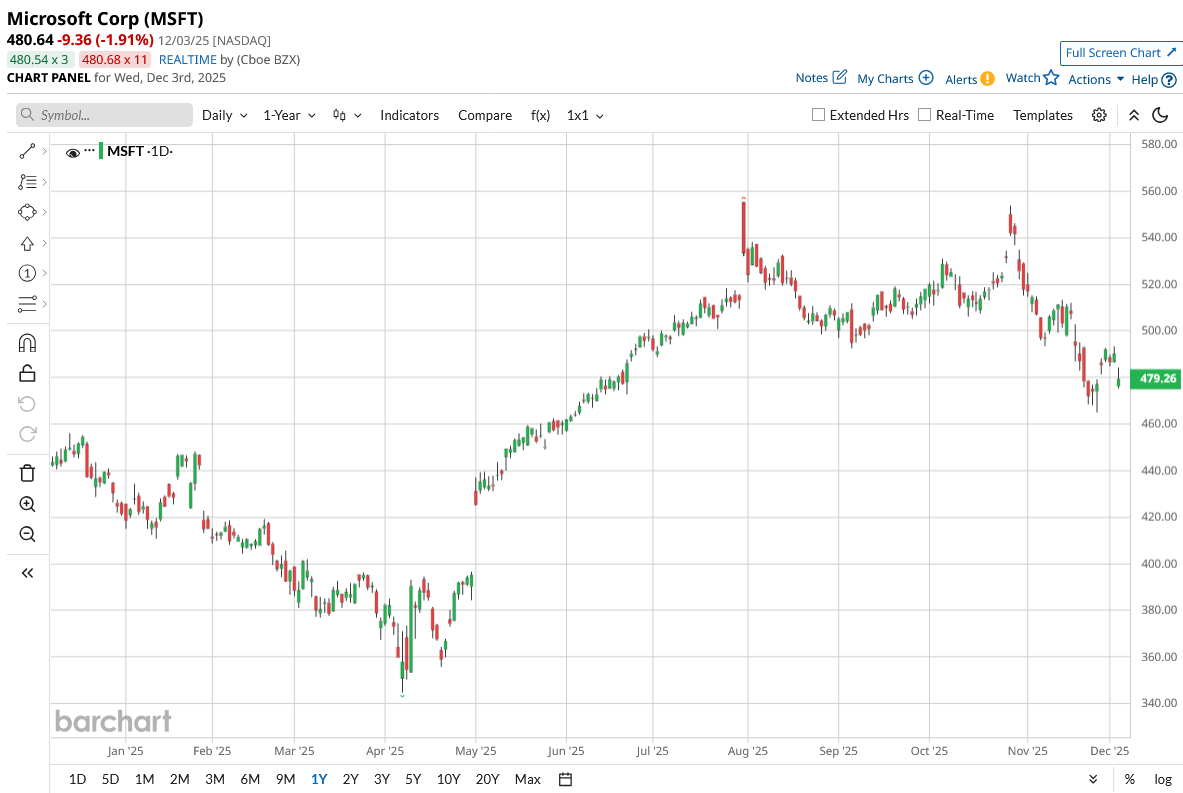
Its forward P/E of 31.04x sits above the sector average of 23.68x, showing investors are willing to pay a premium for that growth and stability.
Income support is part of the story too, with a 3.40% dividend yield and a 0.70% payout, a latest quarterly dividend of $0.910 paid on Nov. 20, a forward payout ratio of 22.85%, and 24 straight years of dividend increases, all ahead of the tech sector’s 1.37% average yield.
The recent numbers back up that confidence. Revenue reached 77.7 billion dollars, up 18% or 17% in constant currency, while operating income rose to 38.0 billion dollars, up 24%. GAAP net income came in at 27.7 billion dollars, up 12%, and non‑GAAP net income at 30.8 billion dollars, up 22%. GAAP EPS increased to 3.72, up 13%, and non‑GAAP EPS to 4.13, up 23%.
That was driven by 49.1 billion dollars in Microsoft Cloud revenue, up 26%; commercial bookings growth of 112%; and a commercial remaining performance obligation of 392 billion dollars, up 51%. Capital spending reached 34.9 billion dollars to meet AI demand, yet free cash flow still climbed 33% to 25.7 billion dollars.
Why Microsoft’s Business Engine Looks Built to Last
Nuvei has expanded its partnership with Microsoft, moving its core payment processing APIs onto Azure and using Azure AI to optimize transactions in real time. The system can now handle more than 10,000 transactions per second with 99.999% availability for enterprise merchants and is built to support over 1 trillion dollars in annual payment volume, improving global reliability and performance while reducing reliance on third parties.
Marvell (MRVL) has also deepened its work with Microsoft, broadening Azure’s cloud security services across Europe through Marvell LiquidSecurity HSMs, adding to existing coverage in Asia and North America. New European certifications allow Azure to support cross-border contracts, ID checks, and other sensitive tasks, cutting time, cost, and manual workload for customers and showing that Microsoft’s security tools can deliver steady, repeatable protection when risk is elevated.
Lumen (LUMN) has launched Defender Advanced Managed Detection and Response for Microsoft Sentinel customers, combining Lumen’s security operations centers, threat hunting, and Black Lotus Labs intelligence with the Sentinel platform. This cloud-based setup is designed to keep up with faster, AI-driven cyberattacks by offering active, context-rich detection and response, giving Microsoft customers a managed security layer that strengthens the stock’s defensive profile as digital threats become more frequent and more complex.
Why the Street Keeps Backing MSFT Stock
For the current quarter ending December 2025, the Street is looking for earnings of $3.86 per share, up from $3.23 a year earlier, which works out to 19.50% YoY growth. On a longer view, the consensus for fiscal 2026 sits at $15.85 per share versus $13.64 last year, a gain of 16.20%.
After Microsoft’s Q1 2026 results, Morgan Stanley’s Keith Weiss called the stock a clear “Buy” on any pullback and pointed to “resilient margins and unstoppable AI growth” as the main reasons. He also argued that the strength of revenue demand and the room for more margin expansion are still not fully appreciated, which lines up with why Microsoft shows up on high‑quality, down‑market stock lists like Triumvirate’s. Wedbush’s Dan Ives pushes that view out further. On CNBC, he said Microsoft’s fiscal 2025 path puts it firmly in the race to be the first 5 trillion‑dollar company, not as a wild call but because he thinks the Street is underestimating hyperscale demand, backed by Microsoft’s more than 400 data centers across 70 regions.
Stepping back, all 48 analysts tracked on the name rate it a “Strong Buy,” and the average price target of $630.59 implies about 29% upside from the current share price.
Conclusion
At this point, Microsoft looks less like a hype-driven AI trade and more like the kind of all-weather compounder Triumvirate had in mind when it flagged “quality” stocks to own into a downturn. The company is leaning hard into AI and cloud, but it’s doing it from a position of balance sheet strength, recurring revenue, and visible earnings growth rather than storytelling alone. That mix is precisely why Wall Street is comfortable slapping a “Strong Buy” label and double‑digit upside on a name this big. Over the next few years, barring a major macro shock, the risk/reward skew still looks tilted toward higher highs rather than a sustained reset.

On the date of publication, Ebube Jones did not have (either directly or indirectly) positions in any of the securities mentioned in this article. All information and data in this article is solely for informational purposes. For more information please view the Barchart Disclosure Policy here.
More news from Barchart
- Microsoft May Be an AI Tech Giant, But It Is Also One of the Safest Stocks to Own Now, According to Wall Street
- Small-Cap Investment Firm Slumps to 52-Week Low: Opportunity or Red Flag?
- Deere Got Hit by Tariffs... Again. Should You Buy the Blue-Chip Dividend Stock on the Dip?
- 3 Dividend Aristocrats on the Edge of a Big Move