
MENLO PARK, CA / ACCESS Newswire / November 9, 2026 / A humanoid does not have to master every household chore to become useful. It may have to carry a metal detector through a hazardous area, inspect a damaged building or operate equipment where sending a person carries a serious risk. Dr. Amarjot Singh, founder and CEO of physical AI company Skylark Labs, argues that mission-critical work gives humanoids a practical starting point: specific assignments where a machine can reduce human exposure to danger.
The argument begins with the work. A team needs access to a hazardous location, information about what is inside or a tool operated at a safe distance. The robot earns its place by helping complete that assignment.
Amarjot Singh's focus includes mine sweeping, reconnaissance and hazardous inspection. His case centers on a question that applies across defense, emergency response and industrial operations: where can a robot provide enough value today to justify putting it to work?
Why Dangerous Work Comes First
A home is an unusually difficult place to introduce a general-purpose robot. Objects move. Instructions are incomplete. The same request can require different actions in every room.
A mission-critical assignment can begin with a narrower task. Carry an instrument. Inspect an entrance. Follow a route. Perform a defined movement with a tool.
The surroundings may be difficult, but the job can be clearly specified. That gives engineers something concrete to build and customers something concrete to evaluate.
A humanoid inspecting a hazardous facility does not need to understand every activity that takes place there. It needs the mobility, perception and manipulation required for its assignment, along with a clear way to return control when it cannot proceed.
Amarjot Singh sees this as a practical route toward broader autonomy. Begin with useful tasks, establish what the machine can handle and expand its capabilities through testing and experience.
The Person Who Would Otherwise Go First
The case for a robot changes when the task involves physical danger.
Someone has to approach the suspected hazard. Someone has to inspect the unstable structure. Someone has to carry an instrument close enough to obtain a useful reading.
A machine that takes on part of that work can create value before it can perform every step independently. It may provide an initial view, carry equipment forward or attempt a task while personnel remain at a safer distance.
Amarjot Singh's position is that useful assistance can arrive before perfect autonomy.
The value depends on the assignment and the consequences of failure. A robot unable to open a damaged door may still return imagery that helps a team choose its next step. A machine that loses confidence must make that uncertainty clear.
For mission-critical work, completing a task and responding appropriately when it cannot be completed are both part of the capability.
The Gap Between a Demonstration and a Deployment
A humanoid can perform an impressive movement and still struggle when one detail changes.
A door handle sits higher. A tool shifts in its hand. A surface provides less traction. A movement that worked in the laboratory now requires an adjustment.
Amarjot Singh places this problem at the center of useful robotics. Learning a sequence is the beginning. The machine must carry that capability across variations it did not encounter during training.
A robot taught to operate one handle should be able to handle related variations without a new engineering effort each time. It also needs to recognize when the difference exceeds what it can safely manage.
That boundary matters in the field. Teams need to know whether a machine can adapt, whether it needs help and whether attempting the task again is likely to produce a better result.
Learning After Deployment
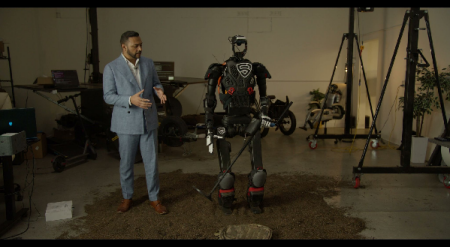
Skylark's Continual Field-Adaptive Models, or CFAMs, are designed around a separation between established knowledge and new experience.
The architecture keeps its underlying learned components stable while storing additional experience in a separate memory. Relevant experience can then be retrieved when a similar situation occurs, without repeatedly retraining the entire model.
The design addresses a persistent difficulty in machine learning: adapting to something new can weaken performance on something already learned.
For a working robot, that tradeoff has immediate consequences. Handling a variation of one tool should not make another familiar task less reliable.
Skylark's research focuses on adaptation within existing skill families. The aim is to widen the range of conditions a known capability can handle. It does not establish that a robot can invent entirely new skills or independently solve any unfamiliar assignment.
That is a specific technical target, and one with practical importance. Many field problems involve variations of familiar work.
What Happens When the Robot Touches Something
Walking brings a robot to the assignment. Manipulation determines what it can do when it arrives.
Holding an instrument at the right angle, turning a handle or positioning a tool requires control of contact and force. A camera can identify an object, but appearance alone does not reveal how firmly to grip it or how much resistance to expect.
A handle may be wet. A valve may be stiff. An object may bend or slip as soon as the robot touches it.
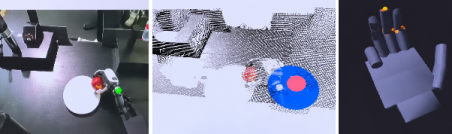
Skylark's Artisan research program with Carnegie Mellon University's Robotics Institute addresses this problem. The program targets manipulation tasks such as grasping unfamiliar objects, opening doors, turning valves and operating tools, using touch and force alongside vision.
For mission-critical applications, these interactions are central to usefulness. Reaching a location provides access. Handling equipment allows the robot to contribute to the work.
Why a Humanoid Body
Much of the physical world is arranged around human movement.
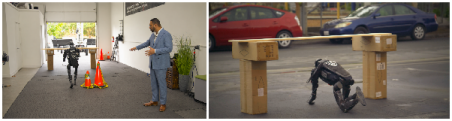
Doors, stairs, handles, work surfaces and handheld equipment assume a certain reach and range of motion. A humanoid could use those interfaces without requiring every location to be redesigned around the machine.
That makes the form attractive for assignments involving existing infrastructure and tools.
The shape alone does not guarantee performance. Balance, endurance, reach and dexterity all affect whether a robot can finish the job. The intelligence controlling those capabilities determines how well they work together.
Amarjot Singh's broader argument is that the value of humanoids will increasingly depend on their brains: how efficiently they acquire a task, how well they handle variation and how much assistance they require.
Customers ultimately need a machine that performs useful work under conditions they can define and assess.
From Mine Sweeping to Broader Hazardous Work
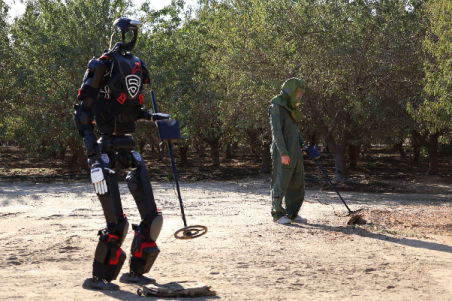
Skylark has reported a demonstration in which a humanoid used a standard-issue metal detector to sweep for landmines. It provides a concrete example of the company's direction: adapting a human tool to a robotic body for a dangerous assignment.
The broader opportunity includes inspection, reconnaissance and work around hazardous infrastructure. Damaged industrial facilities, unstable structures and contaminated environments present related needs for remote physical access.
Those applications remain distinct development and testing challenges. Demonstrating one task does not establish readiness for all of them.
The path forward depends on repeated trials, clear accounts of operator assistance and evidence of performance across changing conditions. Teams need to understand what was demonstrated, what remains planned and where the machine's limits lie.
Amarjot Singh's wager is that humanoids will earn their place through assignments where the need is already clear. Progress will be measured in useful work completed, hazards inspected and time people can avoid spending in dangerous places.
The first meaningful deployment may begin with a simple decision: a machine can take on this part of the job, so a person can remain farther from the risk.
Media Contact:
Noor Jolly
Marketing & Communications, Skylark Labs Inc.
Email: noor.jolly@skylarklabs.ai
Website: skylarklabs.ai
LinkedIn: linkedin.com/in/amarjot-singh-phd-b5269815
SOURCE: Skylark Labs Inc.
View the original press release on ACCESS Newswire