
FORT WORTH, TX / ACCESS Newswire / November 24, 2026 / Vadzo Imaging, a provider of embedded vision camera products for OEMs and system integrators, today positions the Bolt-234MGS as a 2MP UAV Visual Odometry MIPI Camera for motion-accurate feature tracking and autonomous flight navigation. Built on the Onsemi AR0234 sensor and part of Vadzo's MIPI camera portfolio, it combines monochrome output, a global shutter, Full HD imaging, and a 2-lane and 4-lane MIPI CSI-2 interface for NVIDIA Jetson Orin modules. Vadzo presents a 2MP Monochrome MIPI Camera and an AR0234 Monochrome MIPI Camera for UAV makers, together with guidance on frame rate, timestamps, and platform choice.
Why a 2MP UAV Visual Odometry MIPI Camera Must Keep Geometry True
Visual odometry estimates how a vehicle has moved by comparing successive images. The software finds features, which are small patches with strong, distinctive texture such as corners, edges, and marks on the ground, and then follows them from frame to frame. From how the features shift, it computes the motion of the camera, and from the motion it updates the position of the aircraft. The method works without satellite signals, which makes it valuable under bridges, inside buildings, near tall structures, and anywhere that positioning is jammed or unreliable.
The method is only as good as the images that feed it. Most image sensors read the picture row by row, and an aircraft that moves during the readout records each row from a slightly different place. Straight lines lean, the shapes of features change, and the software then measures motion that did not happen. The result is a position that drifts, which is dangerous for an aircraft that relies on it. A global shutter removes the problem at its source, because every pixel records the scene at the same instant, and the features keep the shape they really have.
Time and light add two more demands. The software must know exactly when each frame was taken, because a motion estimate that is accurate in space but wrong in time fuses badly with the readings of an inertial sensor. The aircraft also flies in changing light, over shadows and bright surfaces, and in the dim hours of dawn and dusk, and feature tracking suffers when frames are noisy or blurred. Short exposures reduce blur, and they leave less light for each pixel, which is why a sensor that collects light efficiently, such as a monochrome sensor, helps.
Finally, the camera must connect to a processor that fits the aircraft. Small aircraft have tight limits on weight, power, and space, and a compact embedded computer such as an NVIDIA Jetson module runs the tracking software. The connection between them should be simple, fast, and light. A MIPI CSI-2 link attaches the camera directly to the processor with no bridge chip, which saves weight and delay. Teams that choose a camera for one of these needs and discover the others later must redesign after the aircraft is built, which is slow and costly.
How a 2MP UAV Visual Odometry MIPI Camera Supplies Clean Frames to a Tracker
The Bolt-234MGS is built on the Onsemi AR0234, a 2MP (1920 x 1200) global shutter sensor with a 1/2.6 inch optical format and 3.0 micron pixels, in a monochrome configuration. A global shutter exposes all pixels at once and then reads them out, so the frame is free of the skew that a rolling shutter adds, and the 3.0 micron pixels are large enough to collect a useful amount of light in a short exposure. A monochrome sensor has no color filter array, so more of the incoming light reaches each pixel, and it needs no demosaicing, so every pixel is a real measurement of brightness. Feature trackers work on brightness, and they gain nothing from color, so the sensor suits the task.
A short calculation shows how frame rate and speed combine. Suppose an aircraft flies at 10 meters per second at an altitude of 30 meters, and the camera looks straight down with a lens of 6 millimeters. Each 3.0-micron pixel then covers 30 meters times 3.0 microns divided by 6 millimeters, which is 15 millimeters of ground. At 60 frames per second, the aircraft moves 0.17 meters between frames, so features shift by about 11 pixels. At 30 frames per second, they shift by about 22 pixels, and at 10 frames per second by about 67 pixels. A tracker searches a window around each feature, and smaller shifts mean smaller windows, faster searches, and fewer mistakes, which is why a higher frame rate helps visual odometry. The figures are illustrative and depend on the lens and the altitude.
Exposure time sets blur. At the same speed of 10 meters per second, an exposure of 1 millisecond moves the aircraft 1 centimeter, which is about 0.7 pixels at 15 millimeters per pixel, a blur that most trackers tolerate. An exposure of 5 milliseconds blurs about 3 pixels, which starts to hurt. In dim light, the exposure grows, and a monochrome sensor with large pixels helps keep it short. The global shutter keeps each blurred frame geometrically true, though blur itself still reduces the quality of the features, so teams should favor short exposures and moderate gain, and should test at the darkest light the aircraft will fly in.
Timestamps deserve attention. A visual odometry system usually fuses its estimates with an inertial sensor, and the fusion assumes that each frame is stamped with the time of exposure. If the stamp comes from the host when the frame arrives, it carries jitter from the transfer and the driver. At 10 meters per second, a jitter of 5 milliseconds equals 5 centimeters of position, which the filter must absorb. A hardware trigger or a precise exposure time stamp from the sensor reduces the problem. The datasheet of the color sibling of this camera lists a software trigger and no connected trigger lines, so teams should confirm what the monochrome camera offers, and should measure the jitter on their own platform.
The MIPI CSI-2 interface comes in a 2-lane and a 4-lane option. A Full HD frame of 1920 x 1080 pixels at 8 bits per pixel is about 16.6 million bits, so 60 frames per second needs about 1.0 gigabit per second, and at 10 bits about 1.2. The full 1920 x 1200 frame at 8 bits and 60 frames per second needs about 1.1 gigabits per second. Two lanes can carry that in most configurations, since each lane runs well above half a gigabit per second, and four lanes give more margin and suit higher frame rates or modes. Teams should confirm the available modes, the output format, and the lane rate against the product documentation, and should choose the lane count that matches the carrier board of the module. A short cable, a firm connector, and a clean ground between the camera and the carrier board keep the link free of errors in the electrical noise of an aircraft, where motors and speed controllers add interference.
The camera connects to NVIDIA Jetson Orin platforms, including the Orin Nano, the Orin NX, and the AGX Orin. Feature detection and tracking run well on the graphics processor, and the choice of module depends on how much else the aircraft must do. A compact module may suit a small aircraft running a visual odometry loop alone, and a larger module suits an aircraft that also runs obstacle detection, mapping, and a recognition model. Because a MIPI camera connects straight to the processor without a bridge chip, the weight and the delay stay low. Teams should confirm drivers, lane settings, and frame rates for each module, and should check the weight and the power of the whole payload against the aircraft's budget.
The lens sets the field of view, and the choice shapes both the features available and the distortion to manage. The 1920 pixels across the sensor, at 3.0 microns each, span 5.76 millimeters. A lens of 2.8 millimeters then gives a horizontal field of view of about 92 degrees, which at an altitude of 30 meters covers a ground width of about 62 meters and shows many features, at the cost of strong lens distortion that the software must model. A lens of 6 millimeters gives about 51 degrees and a width of about 29 meters, with finer detail and less distortion. Wide lenses suit slow flight near structures, and narrower lenses suit higher altitude and faster flight. Whichever lens is used, the intrinsic parameters of the camera must be calibrated, and the lens must be locked in place, since a lens that shifts under vibration invalidates the calibration.
Consistent brightness matters too. Many trackers assume that a feature keeps the same brightness from one frame to the next, so an automatic exposure that jumps from frame to frame can confuse them. The exposure control should be smooth, or fixed within a mission for stable lighting, and the exposure and gain values should be logged with each frame so that the software can compensate. Dim scenes call for more gain or a longer exposure, and each has a cost, since gain raises noise and exposure raises blur. Teams should find the balance by flying the real route at different times of day and comparing the number of features that the tracker holds from frame to frame.
A short evaluation plan helps teams avoid surprises. They should calibrate the camera and lens, log every frame with its timestamp, and carry the camera on a walk or a drive through the target environment before the first flight, comparing the estimated path with a known one. They should then repeat the test in the air, in open sky where satellite positioning provides a reference, and measure the drift of the visual estimate over distance. A test over the real terrain at the planned altitude and speed shows whether the scene has enough texture, and a test at dusk shows whether the exposure holds up. Vadzo can review the logs with a customer during evaluation, so that the first flight of the production aircraft behaves like the test platform.
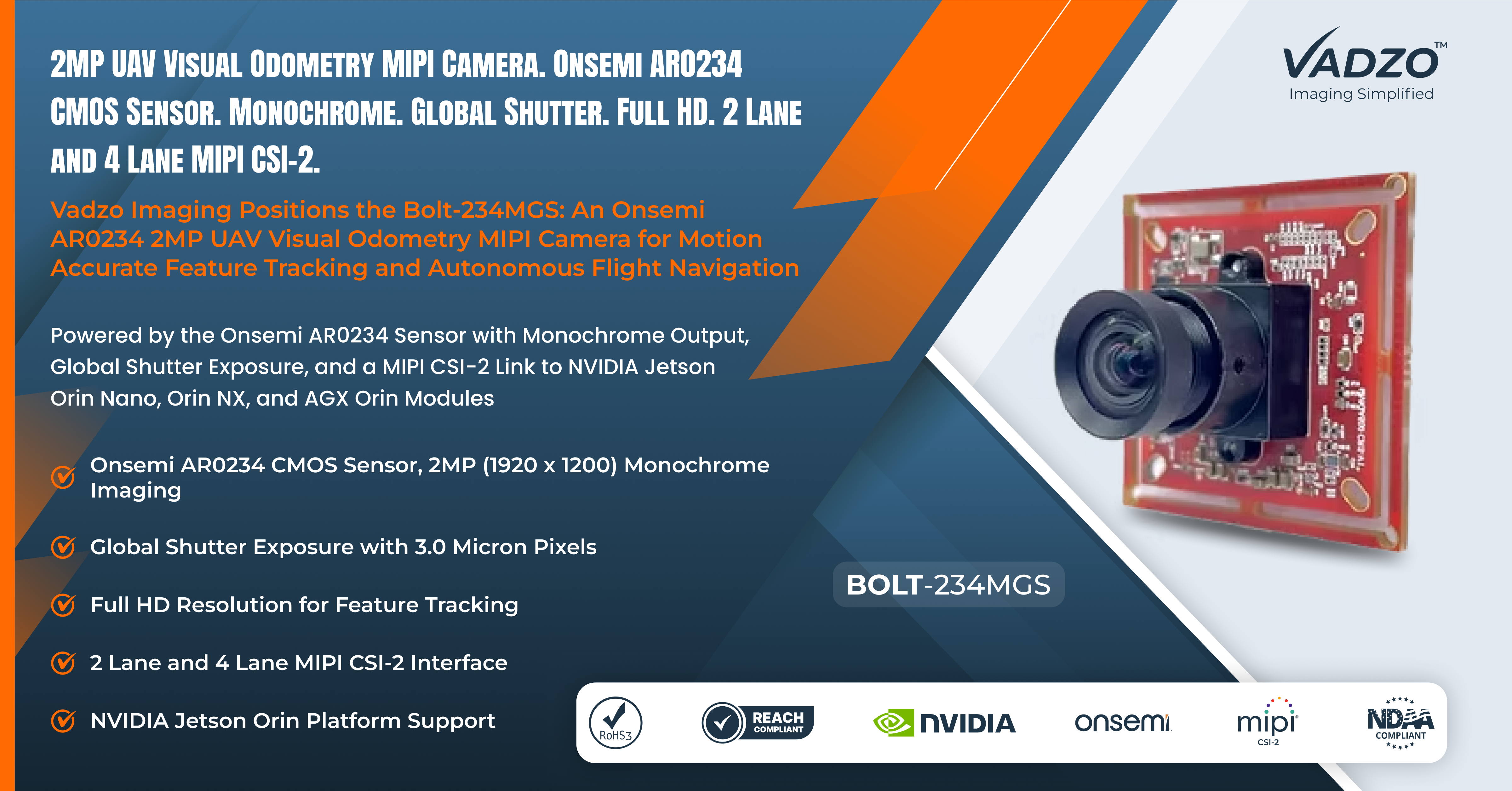
Product Overview: 2MP UAV Visual Odometry MIPI Camera for Autonomous Flight Navigation
The Bolt-234MGS is a 2MP monochrome MIPI module built on the Onsemi AR0234 sensor and positioned for UAV visual odometry. As a 2MP Jetson Orin MIPI Camera, it connects to NVIDIA Jetson Orin platforms, and as a 2MP Global Shutter Mono MIPI Camera, it records every pixel at the same instant. The 2MP Full HD MIPI CSI-2 Camera designation covers its resolution and its interface. The module also serves as an AR0234 Global Shutter Mono MIPI Camera, an AR0234 Jetson Orin MIPI CSI-2 Camera, a 2MP Orin Nano MIPI CSI-2 Camera, a 2MP Orin NX MIPI CSI-2 Camera, a 2MP AGX Orin MIPI CSI-2 Camera, an AR0234 Full HD MIPI CSI-2 Camera, a 2MP Visual Odometry MIPI Camera, an AR0234 Feature Tracking MIPI Camera, and a 2MP Global Shutter MIPI Camera for designs that need a standard MIPI interface.
Key Capabilities of the 2MP UAV Visual Odometry MIPI Camera
Key specs: 2MP (1920 x 1200) Max Resolution | Onsemi AR0234 1/2.6 inch Sensor Format | 3.0 micron Pixel | Monochrome with Global Shutter | 2 Lane and 4 Lane MIPI CSI-2 Interface | S-Mount (M12) Optics
Full HD Resolution
The sensor records Full HD and the full 1920 x 1200 frame, which gives a feature tracker enough pixels to find distinctive points without overloading the processor. A larger frame would offer more features and cost more time per frame, and visual odometry usually gains more from a higher frame rate than from more pixels. The module offers several resolutions, so a team can choose the mode that balances detail and speed, and should confirm the available modes and frame rates in the product documentation. A cropped or reduced mode can raise the frame rate when speed matters more than field of view.
Monochrome Sensor Output
A monochrome sensor has no color filter array, so more light reaches each pixel, and no interpolation softens fine edges. For feature tracking, which uses brightness and texture, this gives stronger signals and cleaner corners than a color sensor of the same resolution, and the frames are smaller to move and to process. Teams that need color for a task such as recognition can add a color module from the same family, and the pair can share one processor. In practice, many aircraft use a monochrome camera for navigation and a color camera for the payload mission.
Global Shutter Exposure
Every pixel is exposed at the same instant, so the movement and vibration of the aircraft do not skew the frame, and features keep their true shape from frame to frame. As an AR0234 Feature Tracking MIPI Camera, the module gives the tracker geometry it can trust. A global shutter does not remove blur from a long exposure, so short exposures remain important, and teams should calibrate the lens, since lens distortion remains after the sensor distortion is gone. Vibration from the rotors can also shake the lens in its mount, so a damped mount and a locked lens protect the calibration over many flights.
NVIDIA Jetson Orin Platform Support
The module connects to NVIDIA Jetson Orin Nano, Orin NX, and AGX Orin, so a team can choose a compact module for a small aircraft or a larger one for heavy workloads without changing the camera. It works as an NVIDIA Jetson MIPI Camera Module and as part of the NVIDIA Jetson Orin MIPI Platform range, and teams should confirm drivers, lane settings, and frame rates for each module. As an AR0234 MIPI Camera Supplier, Vadzo supports lens matching, firmware customization, and enclosure design.
2 Lane and 4 Lane MIPI CSI-2 Interface
The camera offers a 2-lane and a 4-lane MIPI CSI-2 interface through two adapter variants. The 2-lane option suits carrier boards with a simple connector and keeps the wiring light, and the 4-lane option carries more data for higher frame rates and larger modes. MIPI cables are short, so the camera should sit close to the processor, and the connector should be secured against vibration. Teams choose the variant that matches their carrier board and the frame rate they need, and a short test of the full chain at the target frame rate confirms that the link and the processor keep up without dropping frames.
"Visual odometry asks very little of a camera, and it asks for it precisely. Every frame must show the scene as it really is, at a known time, with enough light to find features. The Bolt-234MGS was positioned around those three needs. The global shutter keeps geometry true, the monochrome sensor keeps the light, and the MIPI link feeds an NVIDIA Jetson module that fits the aircraft. We are plain about the limits. A global shutter does not cure blur from a long exposure, timestamps must be measured on the real platform, and visual odometry itself drifts without other references. It is one input to a navigation system, and we help customers test it that way." - Alwin Vincent, Product Manager, Vadzo Imaging.
Application for Autonomous Flight Navigation
Visual Odometry and Feature Tracking
Navigation without satellites relies on tracking features through successive frames. The Bolt-234MGS works as a UAV Visual Odometry MIPI Camera and a Feature Tracking MIPI Camera that supplies skew-free frames to the tracker. In the illustrative example, a flight at 10 meters per second and 60 frames per second moves features by about 11 pixels between frames, a shift that a tracker handles easily. Surfaces with no texture, such as calm water or a uniform field, give a tracker nothing to follow, and teams should plan another reference there, such as an altitude sensor or an inertial sensor, since visual odometry also drifts slowly over distance.
Autonomous Flight and Navigation
Autonomous aircraft combine several sources to know where they are and where to go. The module serves as an Autonomous Flight MIPI Camera, a Flight Navigation MIPI Camera, and a Visual Navigation MIPI Camera whose frames feed a fusion filter together with inertial readings. Teams should measure timestamp jitter, since a few milliseconds of error translate into centimeters of position, and should test in the lighting and the surroundings of the real mission, including the dim hours at the start and end of the day.
Payload Integration
Aircraft have tight limits on weight, power, and vibration. The module connects directly to the processor over MIPI, with no bridge chip, and a damped mount or gimbal keeps vibration away from the sensor. Teams should check the weight and the power of the camera, the lens, and the cable against the budget of the aircraft, secure the connector, and test the whole payload on the ground before the first flight, running the camera and the processor for a long period to see how they behave as they warm up.
Frequently Asked Questions
Q: What is visual odometry, and why does it need a good camera?
A: Vadzo Imaging explains that visual odometry estimates how a vehicle has moved by finding features in one image and following them through the next. It works without satellite positioning, so it suits flights under bridges or near tall structures. The estimate is only as good as the images. A camera that skews the picture, blurs it, or stamps it with the wrong time gives the software false motion, so a global shutter, short exposures, and accurate timestamps all matter.
Q: How does frame rate affect feature tracking?
A: A higher frame rate means smaller shifts between frames. For example, an aircraft at 10 meters per second with each pixel covering 15 millimeters of ground moves features about 11 pixels between frames at 60 frames per second, about 22 at 30, and about 67 at 10. Smaller shifts let the tracker search smaller windows and make fewer mistakes. Vadzo Imaging recommends choosing the frame rate that the processor and the link can sustain, and a 2MP Full HD MIPI CSI-2 Camera at 60 frames per second is a common starting point for fast flight.
Q: Why do timestamps matter for a navigation camera?
A: Navigation software fuses image motion with readings from an inertial sensor, and it assumes each frame is stamped with the time of exposure. A stamp that comes late from the host adds jitter, and at 10 meters per second, a jitter of 5 milliseconds equals 5 centimeters of position. A hardware trigger or a precise exposure stamp reduces the error. Vadzo Imaging recommends measuring the jitter on the real platform, for example by flashing a light at a known time and comparing it with the stamps on the frames that show it.
Q: What is the difference between 2-lane and 4-lane MIPI?
A: The lane count sets how much data the camera can send to the processor. A Full HD frame at 8 bits per pixel and 60 frames per second needs about 1 gigabit per second, which two lanes can usually carry, while four lanes give more margin for higher frame rates and larger modes. The right choice also depends on the carrier board. Vadzo Imaging suggests confirming the lane rate and the connector of the board before choosing.
Q: Why should UAV makers choose Vadzo Imaging as their 2MP global shutter MIPI camera supplier?
A: Vadzo Imaging offers more than a camera module built around a capable sensor. UAV makers receive a monochrome global shutter module with a 2-lane and 4-lane MIPI CSI-2 interface and support for NVIDIA Jetson Orin platforms, with candid guidance on frame rate, exposure, timestamps, and the details to confirm in the documentation, plus engineering support for lens selection, firmware customization, and enclosure design. Vadzo Imaging maintains evaluation kits with no minimum order requirement, so teams can test on their own aircraft before committing to volume production.
Availability
The Bolt-234MGS 2MP UAV Visual Odometry MIPI Camera, built on the Onsemi AR0234 sensor, is available now for evaluation and production orders. Evaluation kits include the camera module, an S-Mount lens, and platform documentation, with no minimum order requirement. UAV teams can measure timestamp jitter on their own platform, record flights at several frame rates and exposures, and confirm streaming on their own NVIDIA Jetson Orin module before committing to a production bill of materials, which tells them more than a datasheet comparison alone. Teams that need a different lens, lane count, or carrier board configuration can ask Vadzo to review the setup. Browse the full range of MIPI camera options at Vadzo's website or discuss OEM integration requirements.
About Vadzo Imaging
Vadzo Imaging is a global provider of embedded vision solutions and delivers high-performance camera technologies and imaging platforms for applications in robotics, industrial automation, UAVs, edge AI, and medical systems. Its products are designed for seamless integration with leading embedded platforms, including NVIDIA Jetson, Rockchip, Raspberry Pi, and NXP i.MX. Vadzo supports customers through hardware customization, firmware development, and module-level drivers, enabling faster development and deployment of vision based systems across MIPI, USB, GigE, Wi-Fi, and SerDes camera interfaces.
Media Contact
Alwin Vincent
Vadzo Imaging
Email: alwin@vadzoimaging.com
LinkedIn: Vadzo Imaging
YouTube: Vadzo Imaging
X: Vadzo Imaging
SOURCE: Vadzo Imaging
View the original press release on ACCESS Newswire