
FORT WORTH, TX / ACCESS Newswire / November 23, 2026 / Vadzo Imaging, a provider of embedded vision camera products for OEMs and system integrators, today launches the Armor-2020MRS-FPD3, a 20MP Monochrome FPD-Link III Camera featuring the Onsemi AR2020 sensor. Part of Vadzo's SerDes camera portfolio, it combines 20MP monochrome resolution, strong low-light sensitivity, near-infrared response, and FPD-Link III long-distance transmission with a single-cable design and low-latency streaming. Vadzo presents an AR2020 Monochrome FPD-Link III Camera and a 20MP Rolling Shutter FPD-Link III Camera for robots, vehicles, inspection stations, and surveillance systems, with guidance on bandwidth, light, and platform choice.
Why a 20MP Monochrome FPD-Link III Camera Must Match Its Link and Its Light
Fine detail is expensive to move. A 20MP frame holds more than twice the pixels of a 4K frame, and a camera that records it must still deliver it to a processor that sits meters away in a protected unit. Software that measures parts, reads printed text, or watches a perimeter gains from every extra pixel, since small features then cover enough pixels to be found. The link, the host, and the power budget pay for them, and a design that ignores the cost discovers the limit late, when the frame rate it needs does not fit the cable it chose.
Light is the second problem, and a color sensor makes it worse. The color filters in front of its pixels each pass only a part of the visible light, about a third in a typical design, and the software then interpolates the missing colors, which softens fine edges. Tasks that use only brightness gain nothing from the color and lose both light and sharpness to it. In dim scenes, at dusk, in shade, or under infrared illumination, the lost light shows up as noise, and noise hides the very detail that high resolution was meant to capture.
Distance is the third. The platforms that want this detail rarely have room for a computer at the camera. A mobile robot keeps its computer low and protected and its camera high for a good view. A gantry holds a camera above a line, and a fence line holds one on a pole. A short parallel ribbon cable cannot span these distances, and a long one carries noise, adds weight, and fails at connectors. A serial link turns many parallel signals into one fast stream that travels over coaxial cable, with control commands returning on the same cable and power sharing it.
Integration closes the list. Teams want the delay between the scene and the decision to stay small, a body that survives vibration, heat, and dust, and a camera that joins a Jetson-based system without custom electronics. Teams that choose a camera for one of these needs and discover the others later must redesign after the hardware is built, and a clear view of all of them at the start saves much of that work.
How a 20MP Monochrome FPD-Link III Camera Moves Fine Detail Over One Cable
The Armor-2020MRS-FPD3 is built on the Onsemi AR2020, a 20MP (5120 x 3840) monochrome rolling shutter sensor with a 1/1.8 inch optical format and 1.4 micron pixels, in the Hyperlux LP back-illuminated design. Back illumination routes light to the photodiode from the rear of the silicon, which improves light collection, and the absence of a color filter array lets more of that light reach each pixel. Every pixel is also a real measurement, not an interpolated value. Because the sensor reads the image row by row, the camera uses a rolling shutter, which suits most scenes and can show skew on very fast motion or strong vibration. A serializer on the camera converts the sensor output into a fast serial stream, and a deserializer on the host converts it back into a standard camera interface. FPD-Link III is the serializer and deserializer family of Texas Instruments, and it carries video on a forward channel over coaxial cable or shielded twisted pair, with control commands travelling back on a slower channel.
A short calculation shows what 20MP means for such a link. A full monochrome frame at 8 bits per pixel is about 157 million bits, and at 10 bits about 197 million bits. The higher-speed FPD-Link III devices carry video at a forward rate of about 4 gigabits per second, a figure teams should confirm for the serializer in use. At 8 bits per pixel, 30 frames per second needs about 4.7 gigabits per second, which does not fit, while 20 frames per second needs about 3.1 gigabits per second and does. A rate of 25 frames per second needs about 3.9 gigabits per second, right at the limit, before any protocol overhead. At 10 bits per pixel, 15 frames per second needs about 3.0 gigabits per second and fits. A faster serial link can carry 8-bit monochrome frames at 30 frames per second, and this link needs a lower frame rate, a reduced mode, or a cropped region. The figures are illustrative, since real streams depend on the output format and on overhead, and teams should confirm the available modes against the product documentation.
A second calculation shows what the pixels give a vision task. Suppose the camera views a field 200 millimeters wide across 5120 pixels, so each pixel covers about 39 microns. A defect 0.15 millimeters wide then spans about 3.8 pixels, and printed characters 1 millimeter tall span about 26 pixels, which is within the range that most text recognition software reads reliably. A camera with 1920 pixels across the same field would cover each character with only about 10 pixels. The figures are illustrative and depend on the lens and the lighting. A lens that resolves detail at the 1.4-micron pixel scale is needed to use the full frame, and teams should test the lens together with the camera.
Near infrared response matters for night operation. The sensor responds across the near infrared, which suits the 850nm and 940nm illuminators that most systems use. An 850nm source gives a stronger signal and shows a faint red glow, and a 940nm source is invisible, which suits covert monitoring, though the signal is weaker. A monochrome sensor has the advantage here, since infrared light carries no color for a color sensor to reproduce, and a color filter array only reduces the signal. Illuminators have limited reach, so long-range night work usually relies on thermal sensors that this camera does not replace, and teams should confirm the response at the wavelengths of their own illuminators.
The single cable design carries video, control data, and power on one coaxial cable, so no separate power run reaches the camera. Power over a long cable loses voltage in proportion to the current. For example, a run with 2 ohms of round-trip resistance drops about 0.4 volts at 0.2 amperes, and the camera and the supply must tolerate that drop, so teams should confirm the power budget and the voltage range for their cable length. The same cable carries the commands that set the exposure and gain and read the sensor. Latency depends on the whole chain. The serializer and deserializer add very little, since the transfer is direct and uncompressed, while the exposure, the readout of a 20MP frame, which can take tens of milliseconds, and the processing on the host add more. Teams should measure the full path, for example by filming a running timer on a display.
The host side needs care. A Jetson module reads camera modules through MIPI CSI-2 lanes, so an FPD-Link III camera needs a deserializer board that converts the serial stream back into MIPI CSI-2 and connects to the module, and teams should confirm which board Vadzo supplies for the platform they use. The camera supports NVIDIA Jetson Orin platforms, and teams should confirm drivers, lane settings, and frame rates for each module they plan to use, including the Orin Nano, the Orin NX, and the AGX Orin. Because monochrome frames are smaller than color frames of the same resolution, the memory and processing load on the host is lighter, which helps on the smaller modules.
Optics decide how much of the sensor's resolution reaches the result, and a worked example shows the trade-offs. Suppose the camera must cover a field 200 millimeters wide from a working distance of 300 millimeters. The 5120 pixels at 1.4 microns span 7.17 millimeters, so the lens needs a focal length of about 10.8 millimeters. At an aperture of f/2.8 and a blur tolerance of two pixels, about 2.8 microns, the depth of field is only about 12 millimeters, so parts must be positioned within about 6 millimeters of the focus plane or the focus must follow them. Closing the aperture to f/5.6 doubles the depth of field, and it also spreads the light from a point into a disc of about 7.5 microns, which is more than 5 pixels across, so the fine detail of a 20MP sensor is lost to diffraction. The practical answer is a good lens at a moderate aperture, steady lighting, and a fixture that holds parts at a repeatable height. The figures are illustrative.
A short evaluation plan helps teams avoid surprises. They should mount the camera on the real platform with the real cable, record in the darkest and the brightest conditions the system will meet, and measure the frame rate, the delay, and the voltage at the camera in each mode. They should check text recognition and defect detection on real parts and not on test charts, and they should try each illuminator band at the real working distance, remembering that the light from an illuminator falls with the square of the distance, so doubling the distance leaves a quarter of the light. They should leave the system running for a long period to see how the link and the module behave as they warm up. Problems with connectors, cable bends, and power usually show up in such a test long before they show up on a bench, and Vadzo can review the results with a customer during evaluation.
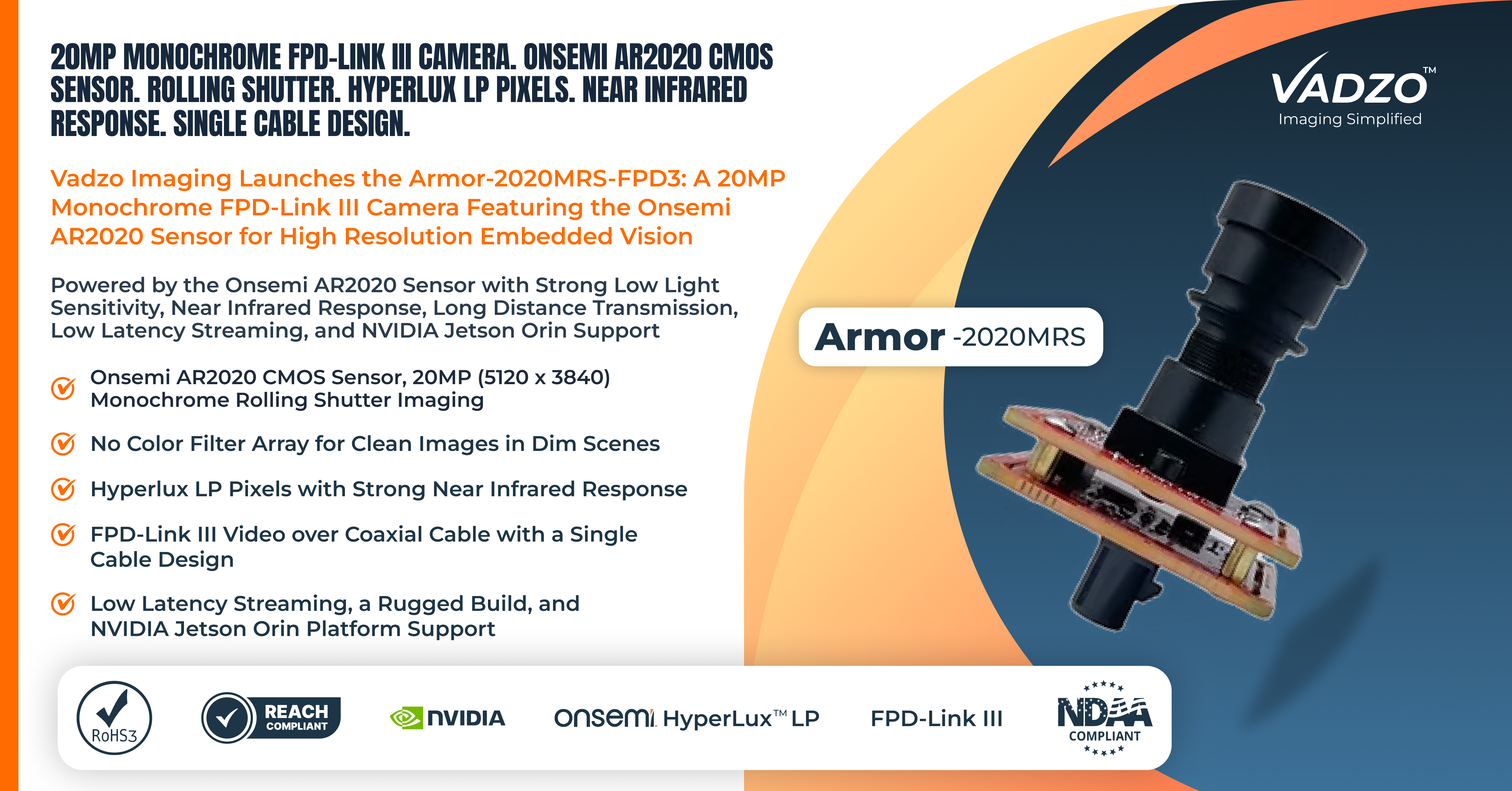
Product Overview: 20MP Monochrome FPD-Link III Camera for High Resolution Embedded Vision
The Armor-2020MRS-FPD3 is a 20MP monochrome FPD-Link III module built on the Onsemi AR2020 sensor. As a 20MP Orin FPD-Link III Camera, it connects to NVIDIA Jetson Orin platforms through a deserializer board, and as a 20MP Low-Light FPD-Link III Camera, it offers back-illuminated pixels with no color filter for dim scenes. The AR2020 FPD-Link III Camera designation covers its sensor and its link. The module also serves as an AR2020 Rolling Shutter FPD-Link III Camera, an AR2020 Orin FPD-Link III Camera, an AR2020 Jetson FPD-Link III Camera, a 20MP Jetson Orin FPD-Link III Camera, an AR2020 Low-Light FPD-Link III Camera, a 20MP Monochrome Low-Light FPD-Link III Camera, an AR2020 Monochrome Low-Light FPD-Link III Camera, and a 20MP FPD-Link III Camera Module for designs that need a long, robust link. It is also an Embedded Vision FPD-Link III Camera, a High-Resolution FPD-Link III Camera, a Monochrome Imaging FPD-Link III Camera, an Embedded Imaging FPD-Link III Camera, and a Monochrome Vision FPD-Link III Camera for engineers who build vision systems.
Key specs: 20MP (5120 x 3840) Max Resolution | Onsemi AR2020 1/1.8-inch Sensor Format | 1.4-micron Pixel | Monochrome with Rolling Shutter | FPD-Link III SerDes Interface | Lens per Module Configuration
Key Capabilities of the 20MP Monochrome FPD-Link III Camera
20MP Monochrome Resolution
The sensor records fine grayscale detail at 5120 x 3840 for measurement, inspection, and text recognition. In the illustrative example, a defect 0.15 millimeter wide spans about 3.8 pixels across a 200 millimeter field, and characters 1 millimeter tall span about 26 pixels. A rolling shutter reads the image row by row, and fast motion or strong vibration can show slight skew, which a short exposure reduces. Vadzo offers global shutter modules for platforms where fast motion is the main concern.
Strong Low Light Sensitivity
With no color filter array, more light reaches every pixel, which gives clean images in dim scenes, and no interpolation adds softness or noise. The pixels are small, at 1.4 microns, so a lens with a wide aperture and steady illumination help considerably, and combining neighboring pixels in a lower resolution mode trades detail for sensitivity. Where light can be added safely, a modest increase usually improves the image more than any setting.
Strong Near Infrared Response
Hyperlux LP pixels perform well under near-infrared illumination for night operation and covert monitoring. An 850nm illuminator gives a stronger signal and a faint red glow, and a 940nm illuminator is invisible and weaker. Illuminators have limited reach, so range should be tested, and long-range night detection usually relies on thermal sensors.
Long Distance Transmission
FPD-Link III carries high-speed video over coaxial cable across long runs between the module and the host, so the camera can sit where the view is and the computer where it is protected. The forward rate limits the stream, and 8-bit monochrome frames at 20 frames per second fit in the illustrative calculation, while 30 frames per second do not. Teams should confirm the cable length and the connector for their design.
Single Cable Design
Video, control data, and power travel on one cable, which cuts wiring and installation time. A long cable drops voltage as current flows, so the power budget and the voltage range should be checked for the real run. As a 20MP FPD-Link III Camera Manufacturer and an AR2020 FPD-Link III Camera Supplier, Vadzo supports deserializer selection, cable planning, and enclosure design for volume programs.
Low Latency Streaming
Direct SerDes transfer keeps the delay added by the link low, since the stream is not compressed, which suits real-time decisions in moving systems. The sensor readout and the host processing usually add more, so the whole chain should be measured, and a reduced mode can cut the delay when speed matters more than detail.
Rugged Armor Build
The module is engineered for vibration and harsh field conditions in automotive and industrial use. Teams should confirm the environmental ratings in the product documentation, secure the connector against vibration with the right cable and strain relief, and test the module on the real platform.
NVIDIA Jetson Orin Platform Support
The module supports NVIDIA Jetson Orin platforms, so a team can choose a compact module for a small robot or a larger one for heavy models without changing the camera. A deserializer board converts the serial stream into MIPI CSI-2, and teams should confirm the board, the drivers, and the lane settings for each Orin module they plan to use.
"Inspection and recognition tasks ask a camera for brightness and edges, and a monochrome sensor gives both without waste. The Armor-2020MRS-FPD3 puts 20MP of grayscale detail on one coaxial cable that also carries control and power, with Hyperlux LP pixels for dim scenes and near-infrared work. We are plain about the limits. FPD-Link III carries less than some other serial links, so full resolution at 30 frames per second does not fit, and the mode and frame rate must be chosen together; long cables drop voltage, and a Jetson needs a deserializer board. We help customers plan the link, the power, and the host before they commit." - Alwin Vincent, Product Manager, Vadzo Imaging
20MP Monochrome FPD-Link III Camera Applications for High Resolution Monochrome Vision
Automation and Robotics
Robots, vehicles, and factory cells carry camera units on moving parts, far from their compute modules. The Armor-2020MRS-FPD3 works as an Autonomous mobile robot's FPD-Link III Camera for navigation and docking, and as an unmanned ground vehicle's FPD-Link III Camera on rugged platforms where a thin coaxial cable replaces a bundle of wires. Fast motion can skew a rolling shutter frame, so a short exposure and a damped mount help, and teams should check weight and connector retention.
Industrial Inspection
Inspection stations need detail at a fixed place. The module serves as an Industrial inspection FPD-Link III Camera where the 20MP frame reveals small defects, and the clean grayscale frames suit text recognition on labels and parts. A strobe with a short exposure freezes parts that move, and a lower resolution mode keeps the frame rate up when a line is fast. A fixture that holds parts at a repeatable height matters as much as the camera, since the depth of field at a moderate aperture is only a few millimeters.
Security and Surveillance
Perimeters and campuses need wide coverage by day and night. The camera works as a Smart surveillance FPD-Link III Camera where its near-infrared response suits illuminated night scenes, 20MP lets one unit cover an area that would otherwise need several, and one cable simplifies mounting on masts and walls. Privacy rules apply to recorded video and belong to the operator, and a clear policy on who may view the footage is part of a sound design.
Frequently Asked Questions
Q: What frame rate can a 20MP monochrome stream reach over FPD-Link III?
A: Vadzo Imaging explains that it depends on the bit depth and the forward rate of the link, which is about 4 gigabits per second in the higher-speed devices. A 20MP frame at 8 bits per pixel is about 157 million bits, so 20 frames per second needs about 3.1 gigabits per second and fits, while 30 frames per second needs about 4.7 and does not. These figures are illustrative, and Vadzo Imaging recommends confirming the available modes.
Q: Does a monochrome camera see better in dim light?
A: It usually collects more light per pixel, because it has no color filter array. The filters of a color sensor each pass only part of the visible light, about a third in a typical design, and software then interpolates the missing colors, which softens fine edges. A monochrome sensor therefore gives cleaner, sharper images in dim scenes. Vadzo Imaging suggests testing at the darkest light the system will meet.
Q: How many pixels does text recognition need?
A: Most text recognition software reads reliably when each character is at least about 20 pixels tall. For example, with a field 200 millimeters wide across 5120 pixels, each pixel covers about 39 microns, so characters 1 millimeter tall span about 26 pixels. Vadzo Imaging recommends calculating the pixel size for the real lens and testing with the real labels and lighting, and a lens that resolves detail at the pixel scale matters as much as the sensor.
Q: Why use infrared light for covert monitoring?
A: Infrared light at 940 nanometers is invisible to people, so an illuminator at that wavelength lights a scene without showing a glow. An 850 nanometer source gives a stronger signal and shows a faint red glow. The sensor must respond at the wavelength, and illuminators reach limited distances. Vadzo Imaging suggests testing the illuminator and the camera together at the working range, since the light from an illuminator falls with the square of the distance, and doubling the distance leaves a quarter of the light.
Q: Why should integrators choose Vadzo Imaging as their 20MP FPD-Link III camera manufacturer?
A: Vadzo Imaging offers more than a camera module built around a capable sensor. Integrators receive a 20MP monochrome module with a single-cable design, low-latency streaming, a rugged build, and support for NVIDIA Jetson Orin platforms, with candid guidance on link bandwidth, voltage drop, and the details to confirm in the documentation, plus engineering support for deserializer selection, lens selection, firmware customization, and enclosure design. Vadzo Imaging maintains evaluation kits with no minimum order requirement, so teams can test on their own platform before committing to volume production.
Availability
The Armor-2020MRS-FPD3 20MP Monochrome FPD-Link III Camera, featuring the Onsemi AR2020 sensor, is available now for evaluation and production orders. Evaluation kits include the camera module, a cable, a deserializer board, and platform documentation, with no minimum order requirement. Integration teams can test frame rates against their own link, measure voltage drop on their own cable, check text recognition on their own labels, and try both illuminator bands on their own NVIDIA Jetson Orin module before committing to a production bill of materials, which tells them more than a datasheet comparison alone. Teams that need a different lens, cable length, or deserializer configuration can ask Vadzo to review the setup. Browse the full range of camera options at Vadzo's website or contact Vadzo at support@vadzoimaging.com to request an evaluation unit or discuss OEM integration requirements.
About Vadzo Imaging
Vadzo Imaging is a global provider of embedded vision solutions and delivers high-performance camera technologies and imaging platforms for applications in robotics, industrial automation, UAVs, edge AI, and medical systems. Its products are designed for seamless integration with leading embedded platforms including NVIDIA Jetson, Rockchip, Raspberry Pi, and NXP i.MX. Vadzo supports customers through hardware customization, firmware development, and module-level drivers, enabling faster development and deployment of vision based systems across MIPI, USB, GigE, Wi-Fi, GMSL2, FPD-Link III, and SerDes camera interfaces.
Media Contact
Alwin Vincent
Vadzo Imaging
Email: alwin@vadzoimaging.com
LinkedIn: Vadzo Imaging
YouTube: Vadzo Imaging
X: Vadzo Imaging
SOURCE: Vadzo Imaging
View the original press release on ACCESS Newswire