
Goldman Sachs recently made a bold call in the electric vertical takeoff and landing space. The investment firm named BETA Technologies (BETA) as its top pick while taking a cautious stance on competitors.
The financial services giant initiated coverage with a “Buy” rating on BETA, citing the company's strategic approach to certification and its vertically integrated business model. It also assigned “Neutral” ratings to Archer Aviation (ACHR) and Eve Holding (EVEX), while assigning a “Sell” rating to Joby Aviation (JOBY) despite its industry leadership position.
Goldman is bullish on BETA’s stepwise certification strategy and explained, “Its stepwise approach to certification with its CTOL aircraft brings forward revenue and accelerates the learning curve without sacrificing the EVTOL timeline. BETA is an aircraft OEM and parts supplier, the most attractive business model in aviation. It has partnered with GE to build a hybrid vehicle for defense and has taken a team approach to selling motors and chargers to competitors, which will help it scale.”
BETA operates as an aircraft manufacturer and parts supplier, a business model Goldman views as the most attractive in aviation. BETA has also partnered with General Electric (GE) to develop a hybrid vehicle for defense applications and sells motors and chargers to competitors, helping it achieve scale.
Goldman analyst Anthony Valentini noted that recent technology advancements and the current administration's focus on reshoring manufacturing provide better visibility into certification timelines for the sector.
However, the analyst emphasized that competition remains fierce and no single winner will dominate the market. Goldman favors companies with aftermarket-rich models, vertical integration, clear revenue visibility, and the capacity to meet future demand.
Is BETA a Good Stock to Buy Right Now?
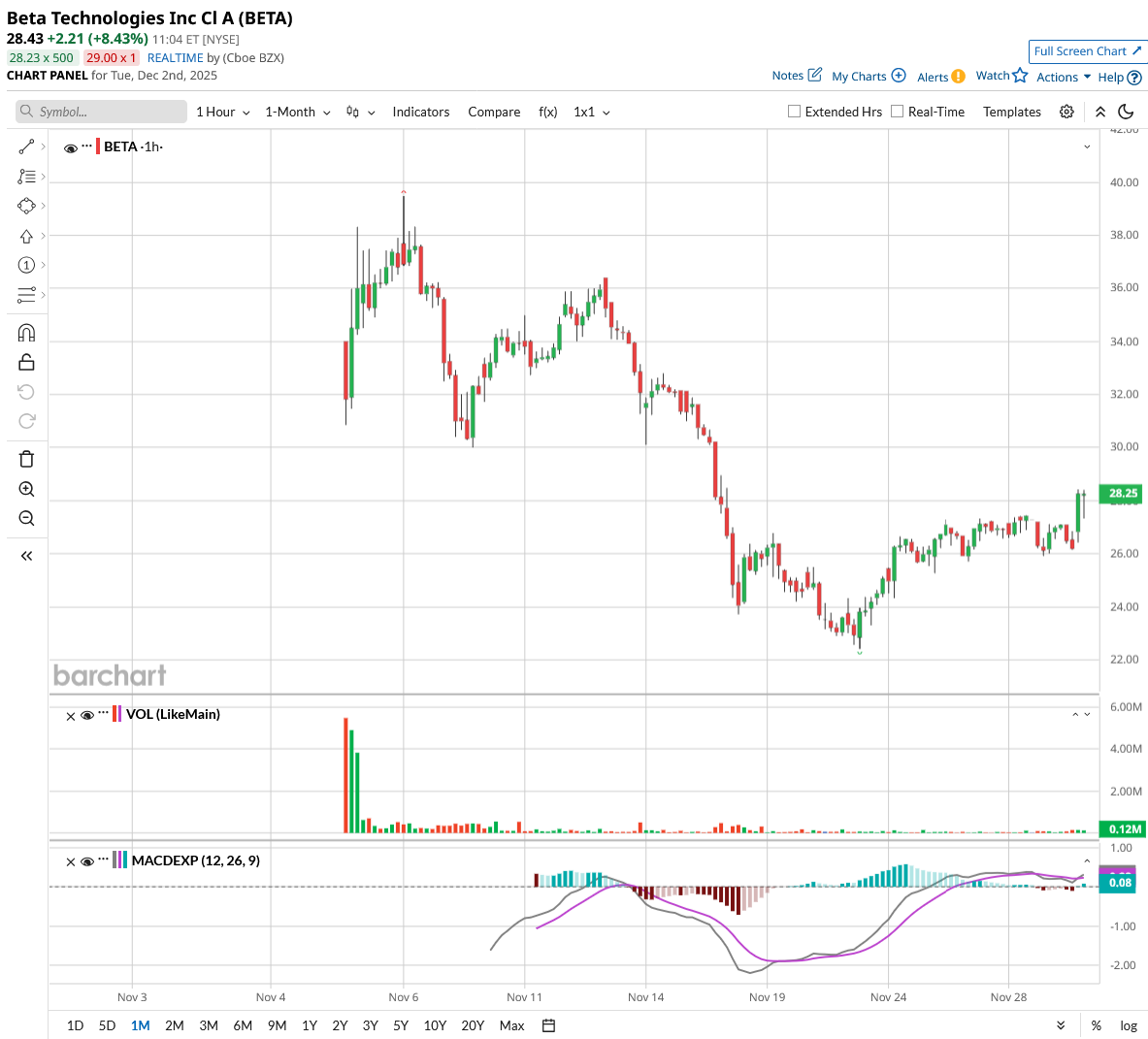
Valued at a market cap of almost $6 billion, BETA Technologies' stock went public last month at $34 per share. It raised over $1 billion through an upsized initial public offering that saw strong investor demand.
The stock began trading on the New York Stock Exchange under the ticker symbol BETA in early November, with Goldman Sachs and Morgan Stanley serving as lead underwriters. The company is now ramping up its autonomous flight technology development through a partnership with Near Earth Autonomy. BETA has logged over 1,000 hours of uncrewed flights on subscale aircraft, demonstrating a range exceeding 158 nautical miles on a single charge.
The collaboration with Near Earth brings expertise in perception systems, guidance technology, and path planning from their work with the U.S. military. Flight testing of the integrated autonomous systems is expected to begin in the first half of 2026.
This autonomous capability will allow BETA aircraft to fly faster, carry heavier payloads, and travel longer distances without a pilot onboard. The development directly supports both defense and commercial customers, including UPS (UPS), Bristow, and military buyers. Current piloted BETA aircraft can carry up to 1,240 pounds or five passengers, but removing the pilot nearly doubles that capacity.
A Focus on Expansion
On the infrastructure front, BETA secured a contract with Abu Dhabi Airports to deploy its certified charging systems across the emirate's emerging air mobility network. The company will install its Charge Cube and Battery Thermal Management System at Al Bateen Executive Airport and Zayed International Airport to support the region's first electric vertical takeoff and landing flights expected in 2026.
This marks another step in BETA's international expansion, adding to its network of over 50 charging sites across the United States and Canada.
Ongoing policy support from Washington has provided additional tailwinds for the advanced air mobility industry. Executive orders directed at the Department of Transportation and the Department of Defense signal the accelerated adoption of autonomous electric aircraft, making BETA an attractive stock for those with a high-risk appetite.
Analysts tracking BETA stock forecast revenue to increase from $30 million this year to $2.8 billion in 2029. The company's free cash outflow is projected to exceed $1.4 billion through 2028, indicating BETA will need to raise additional capital.
Analysts are pretty optimistic on BETA stock, with three out of the four covering it giving it a “Strong Buy” rating and the remainder giving it a “Hold.”

On the date of publication, Aditya Raghunath did not have (either directly or indirectly) positions in any of the securities mentioned in this article. All information and data in this article is solely for informational purposes. For more information please view the Barchart Disclosure Policy here.
More news from Barchart
- Dan Ives Is Betting Big on CoreWeave Stock as an AI Winner. Should You Buy CRWV Too?
- Analysts Say AWS Will Drive ‘Significant Upside’ for Amazon. Should You Buy AMZN Stock Now?
- This Analyst Predicts Tesla Stock Will Crush Traditional Automakers, ‘They Had Plenty of Warning Time’
- Top 100 Stocks to Buy: Par Pacific Holdings Looks Tempting, But Should You Bite?